
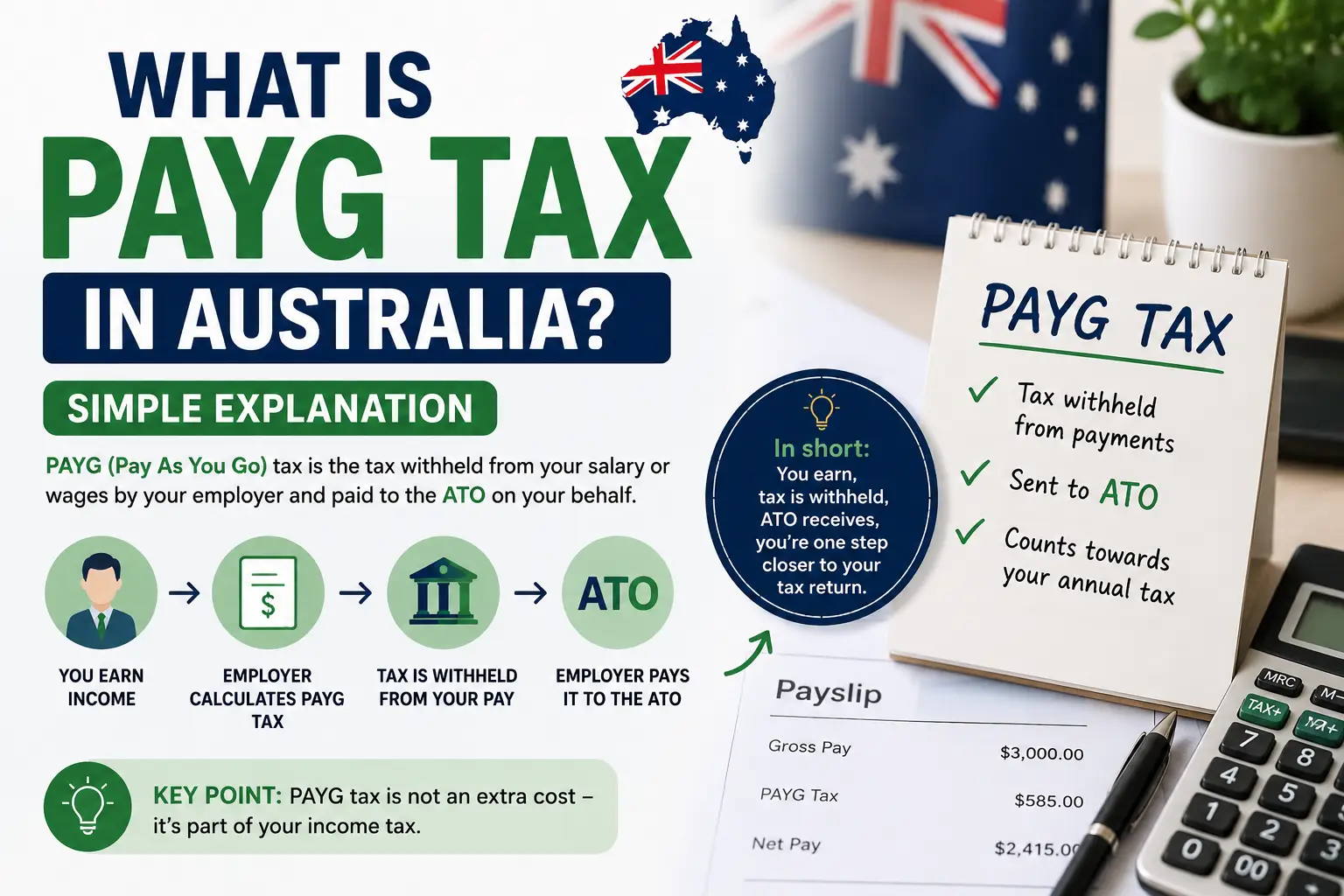
PAYG (Pay As You Go) tax is Australia’s system for collecting income tax progressively from salaries, wages, and business income. This 1000+ word guide breaks it down simply—covering how it works for employees and businesses, tax rates, calculations, and tools like Pay Calculator Australia, Super Calculator, and overtime calculation methods.
PAYG, short for Pay As You Go, is the Australian Taxation Office’s (ATO) method of collecting income tax in real-time rather than waiting for an end-of-year bill. Introduced to replace the old provisional tax system, it spreads payments across the financial year (July 1 to June 30), making tax manageable for individuals and businesses alike. For most salaried workers, your employer handles PAYG withholding automatically from each pay—deducting tax, Medicare levy, and sometimes HELP debts before the money hits your account. This “pay as you earn” approach prevents nasty surprises at tax time.
How PAYG Works for Employees
If you’re an employee, PAYG is deducted via PAYG withholding. Your employer uses ATO tax tables to calculate the exact amount based on your earnings, pay frequency (weekly, fortnightly, monthly), and whether you’ve claimed the tax-free threshold ($18,200 for residents in 2025-26). Here’s the simple flow:
- Employer Calculates: At payday, they annualize your pay (e.g., $2,000 fortnightly × 26 = $52,000/year) and apply the tax scales.
- Deductions Applied: Income tax per brackets, plus 2% Medicare levy (with low-income exemptions).
- Payment to ATO: Withheld amounts are remitted quarterly or monthly via your employer’s Business Activity Statement (BAS).
- Your Records: You get an Income Statement (formerly payment summary) for your tax return, often pre-filled in myGov.
Non-residents face higher rates (no tax-free threshold, starting at 32.5%). Casual workers might see slight variations due to no paid leave loadings.
2025-26 Resident Tax Brackets (for reference):
| Income Range | Tax Rate |
|---|---|
| $0 – $18,200 | 0% |
| $18,201 – $45,000 | 16% |
| $45,001 – $135,000 | $4,288 + 30% |
| $135,001 – $190,000 | $31,288 + 37% |
| $190,001+ | $51,638 + 45% |
Plus Medicare (2%) and potential offsets like LITO ($700 max).
PAYG for Businesses and Sole Traders
Businesses pay PAYG instalments quarterly toward expected income tax. The ATO sets your rate or amount based on prior returns—if your turnover exceeds thresholds (e.g., $2M for quarterly BAS), you lodge with GST. Sole traders and contractors use this for non-withheld income like invoices. Vary instalments if earnings change; overpayments become credits at tax time.
Role of Pay Calculator Australia
A pay calculator in Australia simplifies seeing PAYG in action. Tools like those on moneysmart.gov.au, wagecalculator.com.au, or paycal.com.au let you input salary, frequency, and extras (e.g., HECS) to reveal net pay after PAYG. For example:
- $90,000/year salary → ~$5,800/month gross → PAYG ~$1,500/month → Net ~$4,300.
They factor super (12% employer contribution, not from your pay), Medicare, and offsets—perfect for job offers or budgeting. Cross-check with ATO’s Tax Withheld Calculator for precision.
Superannuation and PAYG Interaction
Super is intertwined but separate: employers pay 12% Superannuation Guarantee (SG) on top of ordinary earnings (rising to 12.5% soon). PAYG doesn’t deduct super from your pay unless you salary sacrifice (pre-tax contributions reduce taxable income, saving ~30-45c/dollar). Use a super calculator (e.g., Finder or QSuper tools) to project retirement balances. Input age, salary, contributions—e.g., $80k earner at 35 could hit $500k by 65 at 7% returns. PAYG refunds often boost voluntary super top-ups.
Overtime Calculation and PAYG Impact
Overtime calculation affects PAYG because extra hours mean higher gross pay, taxed at your marginal rate. Under awards like Manufacturing or Retail:
- Time-and-a-half (150%): First 2-3 hours beyond ordinary (38/week).
- Double time (200%): After that, or weekends/public holidays.
Formula: Overtime Pay = Base Hourly Rate × Multiplier × Hours.
Example: $30/hour base, 5 overtime hours → 2 at 1.5x ($90) + 3 at 2x ($180) = $270 extra. This $270 incurs PAYG at your bracket (e.g., 30% = $81 tax). Use Pay Calculator Australia with overtime inputs for net impact—tools show how bonuses push you into higher brackets temporarily.
Modern awards dictate rules; salaried exempt employees might not get penalties. Track via timesheets for EOFY claims.
Common PAYG Scenarios
- Tax Refunds: Over-withheld PAYG (e.g., no offsets claimed) leads to refunds—average $1,000+.
- Underpayment: Rare, but triggers ATO notices; adjust via tax return.
- Multiple Jobs: Each employer withholds separately; consolidate at tax time.
- Gig Economy: Uber/DoorDash report via TFN; PAYG applies to payouts.
Tips to Manage PAYG Effectively
- Claim tax-free threshold on one job only.
- Update TFN with employers promptly.
- Use myGov for pre-filled returns.
- Salary sacrifice for super/childcare to lower PAYG.
- Lodge early (July-Oct) for quick refunds.
- For businesses, vary instalments via ATO portal.
Why PAYG Matters in 2026
With Stage 3 tax cuts locked in (lower middle rates), PAYG withholding adjusts automatically—increasing take-home by 2-5%. Inflation indexing keeps brackets fair. Amid cost-of-living pressures, understanding PAYG empowers better finances—pair it with Pay Calculator Australia, Super Calculator, and overtime tracking for full control.
Also Read: How to do Study in Australia for International Students
In essence, PAYG is your gradual tax safety net: employers/businesses pay as they go, you focus on net earnings. No more year-end shocks—just steady contributions building toward compliant, prosperous finances.

