
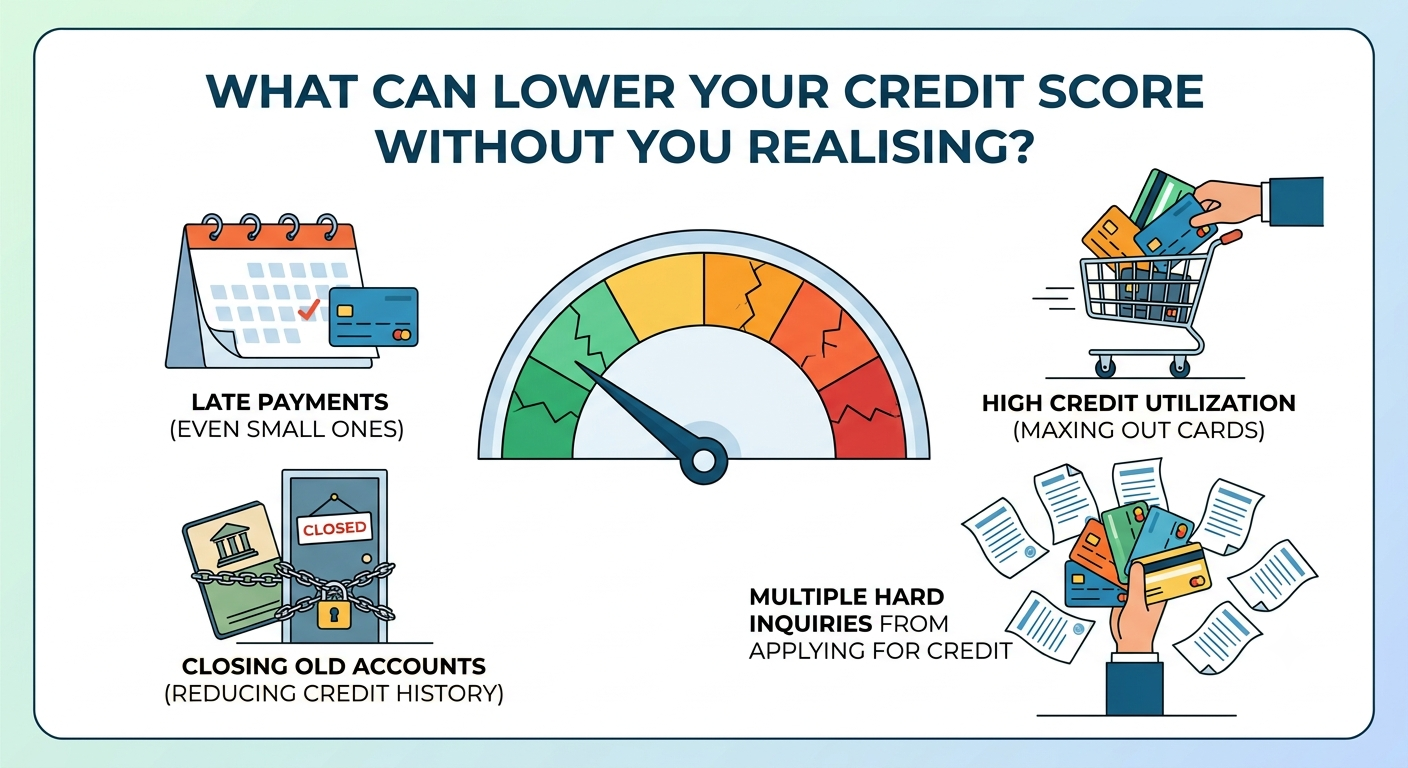
Do you think that your credit scores get affected only when you get a loan or a credit card? Then, you need to change your perception. This is because these scores can change even when you do not perform any financial activity.
Despite paying bills on time, preventing credit cards from maxing out, etc., a small action or even an inaction can harm your scores. There are small financial habits of everyday life that can cause damage to your credit score.
Understanding these hidden issues, which can have a long-term fatal effect, is crucial. When you remain unaware of the problem, the required measures are not taken. As a result of it, your scores become very low over time.
Such situations can be very difficult to handle, as borrowing options will almost shrink. You might even have to take out very bad credit loans at higher rates and by producing a guarantor or pledging an asset.
To safeguard yourself from such scenarios, you must review the hidden factors that can have a negative impact on your credit scores.
Lesser-known reasons your credit scores could fall
The credit scoring model is not easy to understand. Most importantly, it does not work straightforward, but considers a lot of complex factors. There are minor technicalities and financial moves that can tank your scores.
Here are the reasons that can contribute to the fall of your credit score.
Paying off loans early
Many people tend to pay off loans in advance if their financial condition has improved. It can give you the feeling of being free from debts, but this might not have a positive impact on your credit history.
It is true that you will be able to establish yourself as a responsible borrower. However, in this endeavour to free up your monthly cash flow, you are closing down a credit account. How can that turn out to be fatal to your credit scores?
Having a credit mix in your financial portfolio fulfils one of the important criteria for building credit scores. When you pay back a loan early, you cannot keep up with the same credit mix. You had the opportunity to continue with this ongoing credit combination till the term provided by the lender.
Getting rid of old and unused accounts
It is quite common for people to close accounts that are old and no longer seem useful. They do not consider continuing with the financial burden, which is not an actual burden. Cancelling an old account might be easy, but it can drastically affect your credit scores.
This single step can affect your credit history in two ways. First, when you exit from an old credit account, it immediately causes your scores to drop. Therefore, your scores are lowered because of a step that seems to be harmless.
Second, by closing an older account, you are affecting your credit utilisation ratio. Now, the credit utilisation limit is usually higher when you have multiple accounts. When one of these accounts is closed, your limit will be reduced and will influence the overall credit utilisation ratio.
Paying the bare minimum of the credit card balance
You should at least pay the minimum amount to keep your credit card account in proper shape. Despite this, you will not get complete relief from your dependence on credit.
When you make the bare minimum amount of credit card balance, it might feel convenient. However, you fail to realise that debts are being stretched longer. This means that you will have to pay more interest, which is charged on months.
Above all, you are not able to clear the balance at once, and this has become a slow process. It would be better for you to pay more than the minimum if your financial condition permits. This will help in lowering the outstanding balance faster.
Auto-debit can be a blessing or a curse
The auto-pay facility is to make sure that you make payments on time without manually intervening. However, this should not become an over-dependence on technology, which can malfunction at any time. It can be a bank processing glitch or replaced debit card to delay payments.
Now, usually you get a 30-day window within which the lender does not report missed payments to the respective credit bureaus. This 30-days late payments can make your credit scores suffer a lot. To prevent such occurrences, you must keep a tab on whether payments are made on time or not, even when you have opted for auto-debit.
Buy Now and Pay Later services
This type of facility might seem appealing; it allows you to purchase now and pay the price later. You can repay in small instalments, which seems very convenient. These options might seem safer than a credit card, as both operate differently.
However, many of you might remain oblivious to what happens in the back end. These are some of the steps that can bring negative impact on your credit scores. This is because the service provider company may conduct a hard inquiry to make sure about your eligibility.
These hard searches are responsible for lowering the credit scores. Now, if you have been availing of such facilities frequently, imagine the impact they have on your credit scores.
Applying for the same loans multiple times
At the time of getting a car loan or a mortgage, you must compare rates carefully. It will help you find the best offer. If you are doing this within a safe time window (usually 14 to 45 days) for the same loan type multiple times, it will be reported as a single inquiry.
Now, once you step outside the given time limit and apply for different types of loans, your credit scores get negatively impacted. Be smart to align all your loan searched within that safety window. Try to look for opportunities where you can pre-qualify to review loan offers before accepting.
The bottom line
Do not make mistakes like co-signing a loan without knowing its actual pros and cons. Although you might be doing this out of your concern for your close ones, your feelings cannot prevent your credit report from reflecting the freshly added debt balance.

