
For decades, industrial and commercial facilities operated under a simple energy model: predict consumption, accept rising utility rates, and maintain a diesel generator for emergencies. That passive approach is no longer tenable. In today’s volatile energy market, businesses face a complex landscape defined by unpredictable price spikes, punishing peak demand charges, and an increasing urgency to decarbonize operations.
The solution is a fundamental shift from passive consumption to active energy orchestration. Central to this transition is the Industrial & Commercial Energy Storage System (C&I ESS). These sophisticated, behind-the-meter assets are rewriting the rules of power management. By capturing electricity when it is abundant and inexpensive or generating it onsite via renewables—and deploying it strategically, C&I ESS assets allow facilities to slash operational costs, enhance power quality, and guarantee resiliency. This guide will explore the mechanisms, applications, and strategic advantages of modern commercial energy storage.
Decoding the Architecture of Industrial & Commercial Enegery Storage
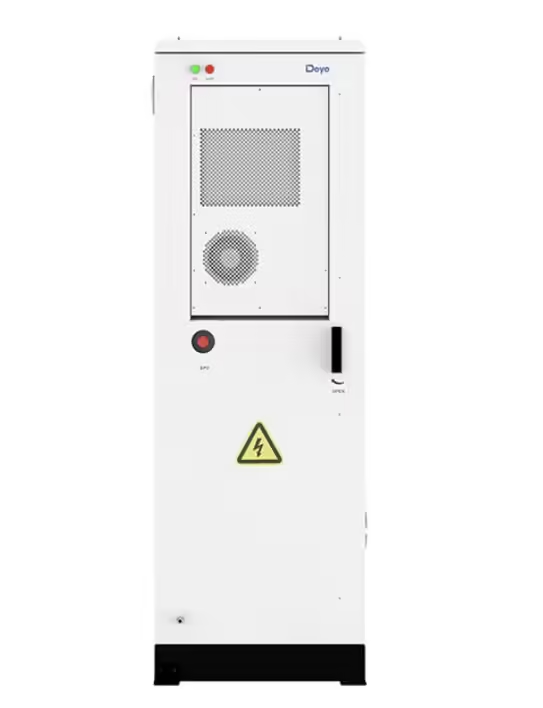
Unlike small residential batteries, an Industrial & Commercial Energy Storage System is a heavy-duty infrastructure asset. These systems are typically housed in robust, climate-controlled enclosures or specialized containers (as seen in the accompanying image) designed for decades of outdoor service. The internal architecture consists of several critical subsystems:
The Battery Modules (The Reservoir)
The core energy reservoir usually utilizes Advanced Lithium-Ion (often Lithium Iron Phosphate, or LFP) chemistry. LFP is favored in commercial applications for its high safety profile, thermal stability, and long cycle life, essential for the daily cycling required in C&I environments.
Power Conversion System (The Gatekeeper)
Batteries natively operate on Direct Current (DC). The utility grid and modern industrial machinery operate on Alternating Current (AC). The Power Conversion System (PCS), or bidirectional inverter, is the gatekeeper. It intelligently manages the high-efficiency conversion between AC and DC, governing both the charging of the reservoir and the dispatch of power back to the facility.
Energy Management System (The Brain)
The Energy Management System (EMS) is the sophisticated software intelligence driving the hardware. Utilizing predictive algorithms, real-time grid monitoring, and historical facility data, the EMS makes microseconds-fast decisions on when to charge, discharge, or hold energy. It is the EMS that maximizes the return on investment by optimizing dispatch for utility rate structures.
Maximizing ROI: Core Applications of Commercial Storage
The primary driver for C&I ESS adoption is cost management. A well-optimized storage system can pay for itself within a few years by targeting specific tariff structures and operational inefficiencies.
Dominating Peak Demand Charges
For many industrial facilities, a huge percentage of the monthly utility bill is not determined by total energy consumption, but by Peak Demand Charges. Utilities charge a premium rate based on the single highest 15-minute or 30-minute spike in usage during peak hours. Starting a massive piece of machinery, like a rock crusher or a large compressor, can set this expensive peak for the entire month.
An Industrial & Commercial Energy Storage System is the ultimate tool for Peak Shaving. The EMS continuously monitors the facility load. When it detects a startup spike that threatens to breach the preset demand threshold, the storage system instantly discharges power. By supplying that extra wattage from the batteries rather than the grid, the facility ‘shaves’ the peak draw, keeping utility charges flat and predictably low.
Capitalizing on Time-of-Use (ToU) Arbitrage
Utilities often utilize Time-of-Use rate structures, where electricity cost varies significantly depending on the time of day. Energy is highly inexpensive during the middle of the night (Off-Peak) and exceedingly costly during periods of high grid stress, such as late afternoon (On-Peak).
A C&I ESS leverages this via Energy Arbitrage. The system automatically charges its batteries during inexpensive Off-Peak windows. When the high-cost On-Peak window arrives, the facility switches to battery power, bypassing the expensive utility rates entirely and operating off the inexpensive stored energy reservoir.
Beyond Cost Savings: Resiliency and Renewable Integration
While cost cutting is the catalyst, modern businesses demand storage for grid independence and sustainability orchestration.
Uninterruptible Resiliency and Power Quality
For critical facilities like data centers, advanced manufacturing plants, or healthcare complexes, a split-second voltage sag or a 30-minute outage can be catastrophic, ruining production runs, corrupting data, and halting operations. While backup generators exist, they often require 10–30 seconds to start and synchronize.
A C&I ESS can be configured to provide instantaneous, uninterruptible power. In the event of a grid failure, the PCS detects the outage in milliseconds and seamlessly transitions the facility to battery power. Crucially, storage systems also provide power conditioning, smoothing out sags, swells, and harmonics from the utility feed, protecting sensitive electronics and extending equipment lifespan.
Optimizing Onsite Renewables
Rooftop or ground-mounted solar arrays are increasingly common on commercial properties. However, solar generation rarely aligns perfectly with a facility’s heavy load requirements. Excess midday solar generation is often pushed back onto the grid for minimal compensation (via Net Metering, where available).
Integrating an Industrial & Commercial Energy Storage System captures this excess, free solar energy. Instead of exporting it, the solar power charges the C&I ESS reservoir. This clean energy is then dispatched later in the day for Peak Shaving or ToU management maximizing the utilization and the ROI of the solar asset itself.
Conclusion
The global energy landscape will only become more volatile as utility grids face increasing stress and the electrification of industrial fleets (EVs) accelerates. Adopting a passive energy model is no longer a viable financial strategy. Transitioning to an active, orchestrated approach via energy storage is an operational imperative. Investing in a high-performance Industrial & Commercial Energy Storage System delivers long-term rate stability, massive Peak Shaving savings, and the essential grid independence required in a digital economy. Partnering with a proven technology leader is crucial for deploying assets designed for continuous high-rate performance. Linio Tech provides scalable, high-efficiency commercial storage architectures that secure your facility’s power quality, optimize renewable assets, and revolutionize your bottom line, keeping your operations resilient and competitive for the decade to come.
-
Tags:

