
Ecommerce personalization has evolved far beyond simply recommending products based on previous purchases or displaying a customer’s first name in an email. Modern shoppers expect brands to understand not only who they are but also what they need at a particular moment. They expect online experiences to reflect their current intent, shopping context, device, location, and stage in the buying journey rather than relying solely on historical customer data.
This shift has given rise to context-aware commerce—an approach that combines customer data with real-time contextual signals to deliver highly relevant shopping experiences. Instead of treating personalization as a static process, context-aware commerce enables retailers to continuously adapt product recommendations, search results, content, promotions, and merchandising based on what customers are doing right now.
For example, a shopper browsing winter jackets from a mobile device during a cold-weather event may require different recommendations than someone searching for the same products weeks later from another region. Similarly, a loyal customer returning to replenish household essentials expects a different experience than a first-time visitor exploring products for the first time. Context transforms identical customer profiles into entirely different shopping experiences.
Powered by artificial intelligence (AI), machine learning, Customer Data Platforms (CDPs), predictive analytics, and real-time behavioral data, ecommerce personalization is increasingly becoming context-aware. This evolution enables retailers to create smarter customer experiences, improve engagement, increase conversions, and maximize long-term customer value.
What Is Context-Aware Commerce?
Context-aware commerce is the ability to personalize digital shopping experiences based on both customer data and the customer’s current situation.
Context may include:
- Real-time browsing behavior
- Search intent
- Device type
- Geographic location
- Time of day
- Weather conditions
- Inventory availability
- Customer lifecycle stage
Rather than relying solely on historical information, retailers use these signals to deliver experiences that match the customer’s immediate needs.
Why Traditional Personalization Is No Longer Enough
Many personalization strategies still depend primarily on:
- Purchase history
- Demographic information
- Customer segments
- Loyalty status
While valuable, these data points provide only part of the customer story.
Customers often change:
- Shopping priorities
- Product interests
- Purchase timing
- Browsing behavior
Without considering current context, personalization can quickly become outdated.
Why Context Matters
Context explains why customers behave the way they do.
Two customers searching for the same product may have completely different intentions.
For example:
- One customer may be researching before making a purchase.
- Another may be ready to buy immediately.
- A third may simply be comparing alternatives.
Understanding context helps retailers deliver more relevant experiences.
How Context-Aware Commerce Improves Ecommerce Personalization
Understanding Real-Time Customer Intent
Behavioral signals provide immediate insight into customer intent.
Important signals include:
- Product searches
- Product views
- Category browsing
- Cart additions
- Wishlist activity
AI evaluates these interactions continuously to personalize the shopping experience while intent is strongest.
Leveraging Unified Customer Profiles
Customer context becomes more valuable when combined with historical information.
Customer Data Platforms (CDPs) consolidate:
- Purchase history
- Browsing behavior
- Search activity
- Loyalty participation
- Customer service interactions
Unified profiles enable retailers to balance long-term customer preferences with current shopping behavior.
Personalizing Product Recommendations
Recommendation engines become significantly more effective when they consider context.
Recommendations may adapt based on:
- Current browsing session
- Recent searches
- Product affinity
- Purchase history
- Inventory availability
Customers receive suggestions that reflect both historical interests and immediate intent.
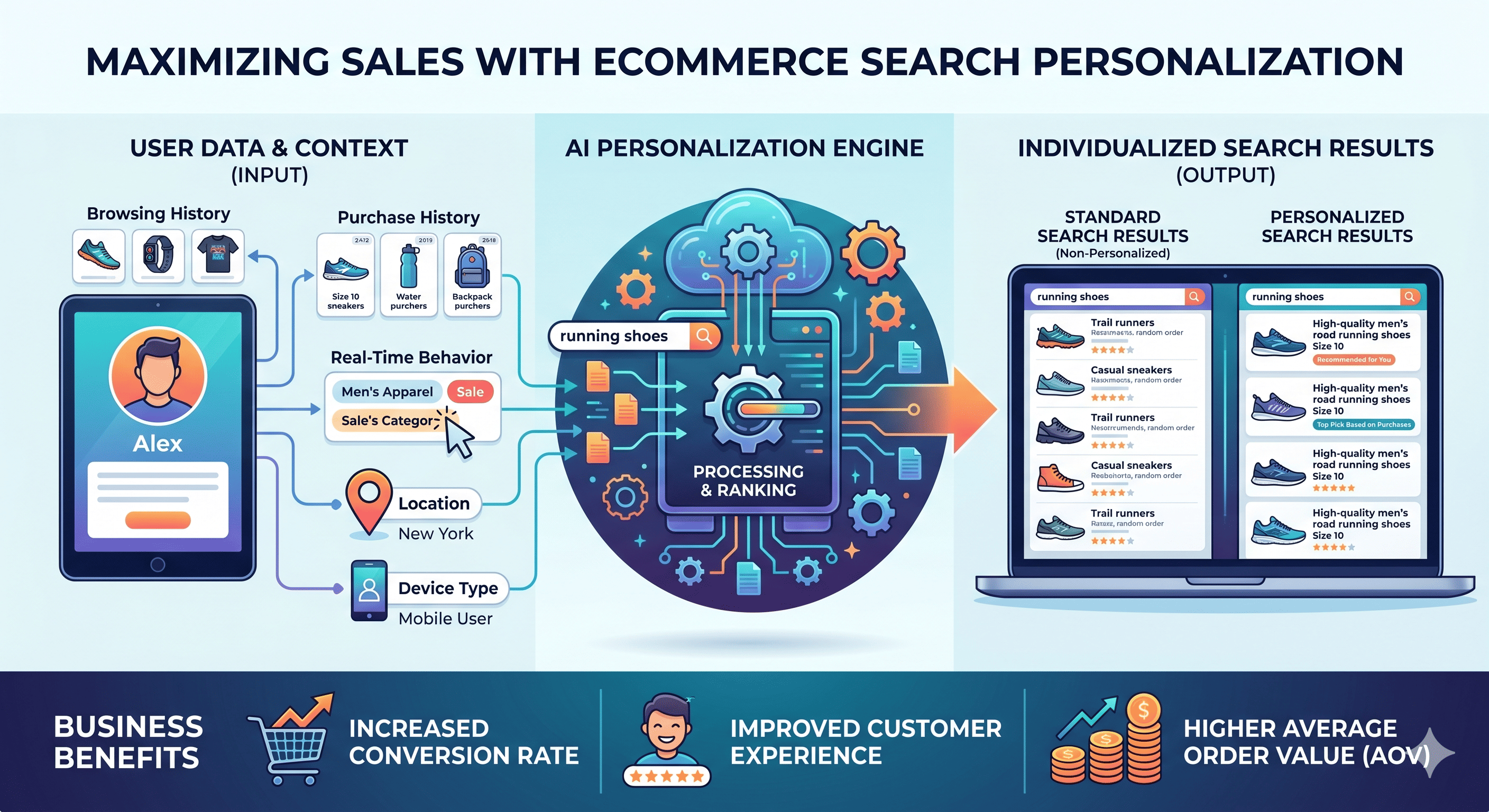
Improving Ecommerce Search
Search is one of the clearest indicators of customer intent.
Context-aware search personalization considers:
- Previous searches
- Current browsing activity
- Customer preferences
- Location
- Product availability
This helps customers discover relevant products more quickly.
Delivering Dynamic Content
Website content should adapt as customer context changes.
Retailers can personalize:
- Homepage banners
- Promotional messages
- Featured products
- Category pages
- Landing pages
Dynamic content improves engagement by reflecting each visitor’s current interests.
Optimizing Promotions
Context-aware commerce helps retailers deliver promotions that match customer needs.
Examples include:
- Loyalty rewards for repeat customers
- Limited-time discounts for cart abandoners
- Seasonal promotions based on regional weather
- Category-specific offers aligned with browsing activity
This improves promotional relevance while protecting profit margins.
Supporting Omnichannel Experiences
Customer context extends across multiple touchpoints.
Examples include:
- Ecommerce websites
- Mobile applications
- Email campaigns
- Loyalty platforms
- Physical stores
Context-aware personalization ensures every interaction reflects the customer’s latest activity regardless of channel.
Adapting to Customer Lifecycle Stages
Customers require different experiences depending on where they are in their journey.
Examples include:
New Visitors
Educational content and introductory messaging.
Active Shoppers
Product recommendations and promotional offers.
Loyal Customers
Exclusive rewards and personalized bundles.
Returning Customers
Replenishment reminders and loyalty updates.
Context-aware systems automatically adjust experiences based on lifecycle stage.
Leveraging Predictive Analytics
Context-aware commerce also looks ahead.
Predictive analytics estimates:
- Purchase likelihood
- Churn probability
- Product affinity
- Next-best action
AI combines these predictions with real-time context to personalize customer experiences more accurately.
AI Enables Intelligent Decision-Making
Artificial intelligence processes millions of customer interactions simultaneously.
AI can:
- Predict customer intent
- Optimize recommendations
- Personalize merchandising
- Adjust promotions
- Recommend next-best actions
Machine learning continuously improves these decisions as customer behavior evolves.
Inventory-Aware Personalization
Customer experiences should also reflect inventory conditions.
Context-aware personalization considers:
- Product availability
- Local inventory
- Fulfillment options
- Delivery timelines
This prevents retailers from promoting unavailable products while improving customer satisfaction.
Benefits of Context-Aware Commerce
Better Customer Engagement
Relevant experiences encourage stronger interaction.
Improved Product Discovery
Customers find products faster.
Higher Conversion Rates
Context-aware personalization supports purchasing decisions.
Increased Average Order Value
Relevant recommendations encourage larger purchases.
Stronger Customer Loyalty
Customers appreciate personalized experiences that reflect their current needs.
Greater Customer Lifetime Value
Long-term personalization strengthens customer relationships.
Common Challenges Retailers Face
Fragmented Customer Data
Context requires unified information from multiple systems.
Real-Time Processing Requirements
Customer context changes continuously.
Technology Integration Complexity
Multiple business platforms must exchange data efficiently.
Privacy and Compliance Requirements
Customer data must be managed responsibly and transparently.
Addressing these challenges is essential for successful implementation.
Best Practices for Context-Aware Personalization
Build Unified Customer Profiles
A complete customer view improves personalization quality.
Capture Real-Time Behavioral Signals
Current customer activity provides the strongest context.
Leverage AI-Powered Decisioning
Machine learning improves personalization accuracy.
Connect Every Customer Touchpoint
Consistent experiences strengthen omnichannel engagement.
Continuously Optimize Customer Experiences
Customer behavior evolves continuously.
Key Metrics to Track
Organizations should monitor:
- Conversion rate
- Customer engagement rate
- Average order value
- Product discovery rate
- Customer retention rate
- Customer lifetime value
- Revenue per visitor
These metrics help evaluate the effectiveness of context-aware personalization.
Conclusion
The future of ecommerce personalization is no longer defined by customer data alone. As customer expectations continue to evolve, retailers must understand not only who their customers are but also what they are trying to accomplish at each moment of their shopping journey.
Context-aware commerce makes this possible by combining AI, machine learning, predictive analytics, real-time behavioral signals, and unified customer data to create adaptive shopping experiences that respond to changing customer needs in real time. Instead of relying on static personalization, retailers can continuously adjust recommendations, content, search results, and promotions based on immediate customer context.
As digital commerce becomes increasingly competitive, organizations that embrace context-aware personalization will be better positioned to improve customer engagement, increase conversions, strengthen long-term loyalty, and deliver the intelligent shopping experiences that modern consumers expect.

