
Today’s customers rarely complete their shopping journey on a single device. A customer might discover a product on a smartphone during their morning commute, continue researching on a laptop during work hours, compare alternatives on a tablet in the evening, and finally complete the purchase through a mobile app or even in a physical store. Throughout this journey, they expect the experience to remain consistent regardless of the device they use.
However, many businesses still struggle to deliver this continuity. Customers often encounter different recommendations, inconsistent promotions, or irrelevant content when switching between devices. Shopping carts disappear, browsing history is lost, and personalized experiences fail to carry over from one interaction to the next. These disconnects create friction that can reduce engagement, delay purchases, and weaken customer trust.
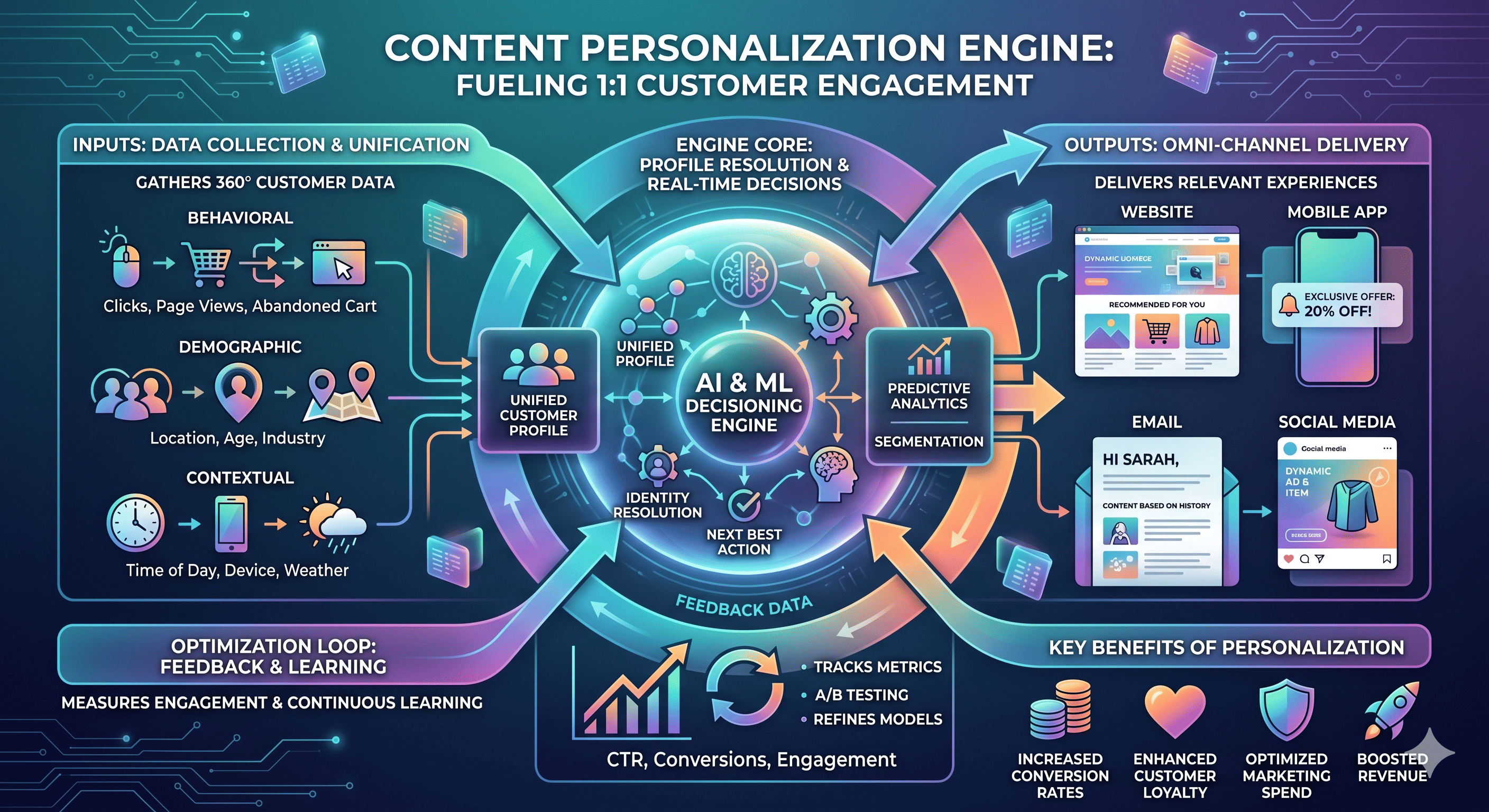
Content personalization engine help eliminate these gaps by delivering consistent, context-aware experiences across every device. Powered by artificial intelligence (AI), machine learning, Customer Data Platforms (CDPs), predictive analytics, and real-time behavioral insights, these platforms recognize customers as they move between smartphones, tablets, desktops, mobile apps, and other digital touchpoints. Rather than personalizing individual sessions independently, they create a unified experience that evolves continuously as customers interact with the brand.
As digital journeys become increasingly multi-device, content personalization engines are becoming essential for creating seamless cross-device experiences that improve engagement, increase conversions, and strengthen long-term customer loyalty.
Why Cross-Device Experiences Matter
Modern shopping journeys span multiple devices.
A typical customer may:
- Discover a product on social media using a smartphone
- Research features on a desktop computer
- Compare reviews on a tablet
- Complete the purchase through a mobile app
Customers expect brands to recognize them across every interaction.
Consistent experiences reduce friction and improve customer confidence.
The Challenges of Multi-Device Customer Journeys
Retailers often personalize experiences separately for each device.
This creates several challenges.
Inconsistent Recommendations
Products recommended on one device may disappear on another.
Lost Customer Context
Browsing history and preferences may not transfer across sessions.
Disconnected Promotions
Customers receive different offers depending on the device they use.
Fragmented Customer Profiles
Customer data remains isolated across multiple systems.
These issues interrupt the customer journey and reduce engagement.
What Is a Content Personalization Engine?
A content personalization engine is an AI-powered platform that dynamically delivers personalized content based on customer behavior, preferences, context, and intent.
It can personalize:
- Websites
- Mobile applications
- Landing pages
- Product recommendations
- Promotional banners
- Marketing content
The objective is to deliver relevant experiences consistently across every digital touchpoint.
Why Cross-Device Personalization Is Becoming Essential
Customers no longer think in terms of channels or devices.
They expect brands to remember:
- What they viewed
- What they searched for
- What they added to their cart
- What they purchased
- What interests they demonstrated
Regardless of whether they return on another device, customers expect the experience to continue seamlessly.
How Content Personalization Engines Create Seamless Cross-Device Experiences
Building Unified Customer Profiles
Cross-device consistency begins with customer identity.
Customer Data Platforms (CDPs) consolidate information from:
- Ecommerce websites
- Mobile applications
- CRM systems
- Loyalty platforms
- Customer service channels
Unified customer profiles ensure every device references the same customer information.
Resolving Customer Identity Across Devices
Customers frequently switch between:
- Smartphones
- Tablets
- Desktop computers
- Mobile applications
Content personalization engines use identity resolution to connect these interactions into a single customer profile.
This enables consistent personalization regardless of device.
Leveraging Real-Time Behavioral Signals
Customer interests evolve continuously.
Behavioral signals include:
- Product searches
- Product views
- Category browsing
- Cart additions
- Session activity
These interactions update customer profiles immediately across every connected device.
Delivering Consistent Product Recommendations
Recommendation engines use unified customer intelligence to deliver relevant products regardless of where customers engage.
Recommendations reflect:
- Browsing behavior
- Purchase history
- Product affinity
- Real-time intent
Customers receive continuity rather than restarting their shopping journey.
Personalizing Website Experiences
Content personalization engines dynamically adapt:
- Homepage content
- Promotional banners
- Product collections
- Navigation
- Category pages
Desktop and mobile experiences remain aligned while respecting device-specific layouts.
Supporting Mobile App Personalization
Mobile applications often serve different customer needs than desktop websites.
Personalization engines optimize:
- Push notifications
- Product recommendations
- Loyalty experiences
- In-app promotions
These experiences remain synchronized with website activity.
Preserving Shopping Progress
Customers expect shopping carts and browsing sessions to follow them across devices.
Content personalization engines help preserve:
- Saved products
- Wishlist items
- Recently viewed products
- Personalized recommendations
This reduces friction and encourages purchase completion.
Delivering Consistent Promotions
Promotions should remain synchronized across channels and devices.
Customers should encounter consistent:
- Discounts
- Loyalty rewards
- Personalized offers
- Promotional messaging
Consistency improves customer trust and campaign effectiveness.
Supporting Omnichannel Customer Journeys
Cross-device experiences often extend beyond digital channels.
Customers may interact through:
- Websites
- Mobile applications
- Customer service
- Physical stores
Content personalization engines help coordinate these touchpoints into one connected customer journey.
Leveraging Predictive Analytics
Predictive models estimate:
- Purchase likelihood
- Product affinity
- Customer lifetime value
- Next-best action
These insights remain available regardless of device, allowing personalization to continue naturally throughout the journey.
AI Enables Continuous Adaptation
Artificial intelligence continuously analyzes customer behavior across devices.
AI can:
- Predict customer intent
- Recommend products
- Personalize content
- Optimize promotions
- Identify next-best actions
Machine learning improves personalization as more customer interactions occur.
Benefits of Cross-Device Personalization
Better Customer Engagement
Consistent experiences encourage deeper interaction.
Improved Product Discovery
Customers continue exploring products without interruption.
Higher Conversion Rates
Reduced friction supports purchasing decisions.
Stronger Customer Retention
Connected experiences strengthen long-term loyalty.
Higher Customer Lifetime Value
Customers engage more frequently over time.
Greater Brand Consistency
Unified experiences build customer trust.
Common Challenges Organizations Face
Fragmented Customer Data
Customer information often exists across disconnected platforms.
Identity Resolution Complexity
Accurately connecting customer interactions requires advanced technology.
Real-Time Synchronization Requirements
Personalization must update immediately across devices.
Privacy and Compliance Considerations
Customer identity and behavioral data must be managed responsibly.
Addressing these challenges is essential for delivering seamless experiences.
Best Practices for Cross-Device Personalization
Build Unified Customer Profiles
A complete customer view improves personalization quality.
Use Identity Resolution
Recognize customers consistently across every device.
Capture Real-Time Behavioral Signals
Current customer activity strengthens personalization accuracy.
Leverage AI-Powered Decisioning
Machine learning enables adaptive customer experiences.
Continuously Optimize Cross-Device Journeys
Customer behavior evolves continuously.
Key Metrics to Track
Organizations should monitor:
- Cross-device conversion rate
- Customer engagement rate
- Session continuity
- Customer retention rate
- Average order value
- Customer lifetime value
- Personalization performance
These metrics help evaluate the effectiveness of cross-device personalization.
Conclusion
As customers increasingly move between smartphones, tablets, desktops, mobile apps, and physical stores, seamless cross-device experiences have become a fundamental expectation rather than a competitive advantage. Customers want brands to recognize them instantly, preserve their shopping progress, and provide personalized experiences that remain consistent throughout their journey.
Content personalization engines make this possible by combining AI, Customer Data Platforms, identity resolution, predictive analytics, and real-time behavioral insights to create unified customer experiences across every device. Instead of treating each interaction as a new session, businesses can maintain continuity that improves product discovery, reduces friction, and encourages long-term engagement.
As omnichannel commerce continues to evolve, organizations that invest in cross-device personalization will be better positioned to deliver consistent customer experiences, strengthen loyalty, improve conversion rates, and achieve sustainable digital growth.

