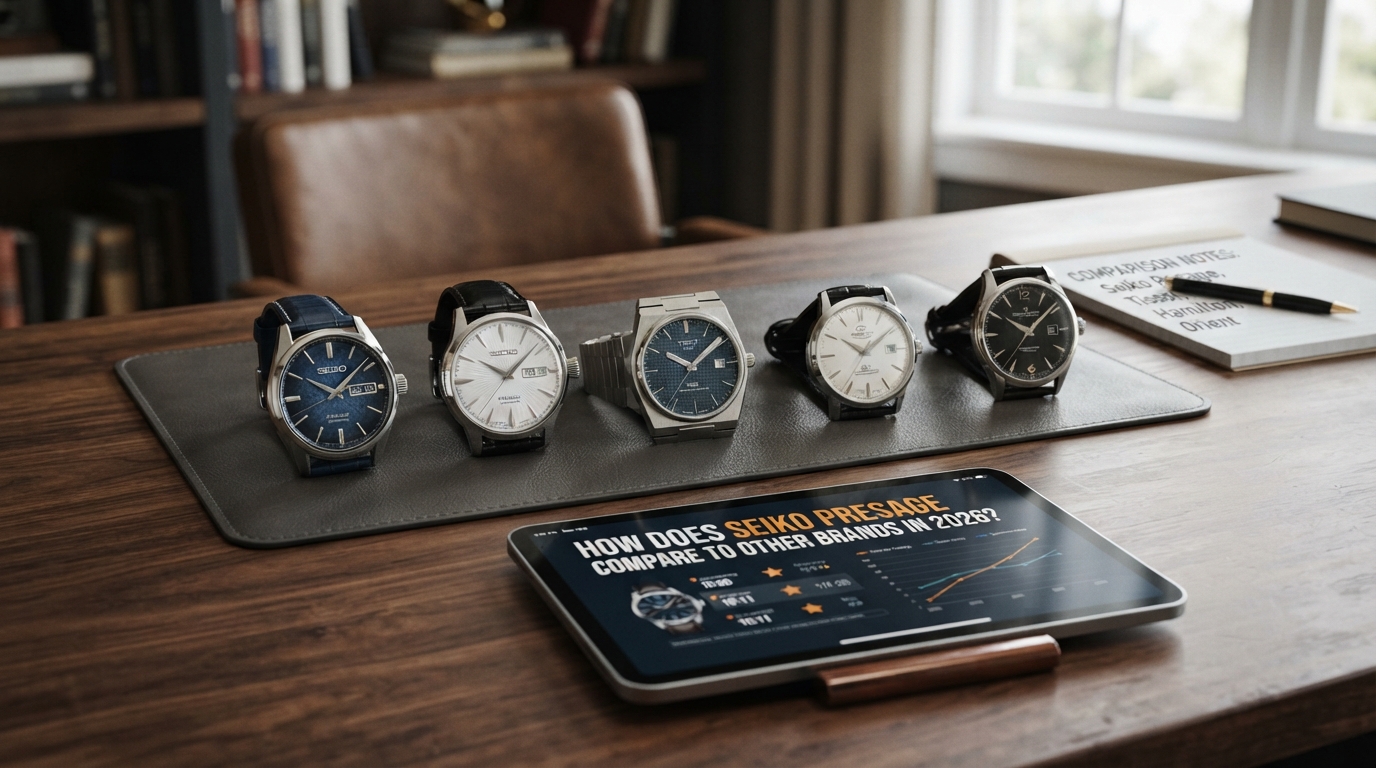
If you’re looking around for an automatic dress watch somewhere between $300 and $1,500, it can feel genuinely confusing. Like Tissot, Hamilton, Orient, Citizen, and then a whole long parade of microbrands are all showing up in roughly the same little lane. So where does Seiko Presage really sit in 2026? Not in a “this brand wins everything” kind of way, more like in practical terms—I mean, against the real options you’d actually end up considering buying.
The answer depends on what you care about most, and that’s what this comparison will cover.
Dial Quality: The One Area Where Seiko Pulls Clearly Ahead
This is the most obvious win for the Presage and the reason most people end up choosing it over the competition. Dial techniques like porcelain, urushi lacquer, and hand-guilloche patterns put it at a level no Swiss brand matches under $2,000. That’s not marketing. If you hold a Presage Cocktail Time next to a Tissot PRX at the same price, the difference in the dial is something you notice immediately, not after reading a spec sheet.
The Cocktail Time sunburst dials and the textured Sharp Edged series are regularly cited as the best dials available under $500. For buyers who spend the day glancing at their wrist, that matters more than a lot of other things on the box.
Orient is the closest rival in this price range. An Orient Kamasu at around $250 offers sapphire crystal and 200m water resistance, which is genuinely impressive for the price. But the dial work is a step below. Orient is better on certain specs. Presage is better to look at almost every time.
What You Give Up: Crystal and Movement
This is where the Presage asks you to compromise, especially at the entry level. The 4R35 movement used in Cocktail Time models is rated at plus or minus 25 seconds per day, which is on the lower end for a modern automatic. It’s not going to bother most people day-to-day, but it’s worth knowing.
Tissot and Hamilton offer sapphire crystal in nearly all their automatic models, while Seiko’s entry-level Presage models use Hardlex, a hardened mineral glass. Hardlex is tougher than regular mineral glass, but it’s not sapphire, and it will scratch over time in ways sapphire won’t.
The good news is that Seiko’s mid-tier and higher Presage models address both issues. The Sharp Edged series at around $500 uses the 6R35 movement with a 70-hour power reserve, and sapphire crystal is standard. So the entry models make trade-offs, but the pricier ones don’t, which is worth keeping in mind when you’re comparing prices.
How the Seiko Presage Stacks Up Against Tissot and Hamilton
Tissot’s main argument is, honestly, consistency. Like good case finishing, sapphire crystal across most models, and Swiss Made on the dial for buyers who care about that sort of thing. The PRX kind of wins on bracelet design and that more contemporary vibe, while the Presage wins on dial quality and overall value. If you want something with a sharp modern look and a well-done integrated bracelet, Tissot has a real advantage. But if you want a dial that looks like a person and actually set it up and made it, the Presage is the tougher one to just walk away from.
Hamilton kind of sits in its own lane. The Khaki Field, around $400 to $450, is a no-nonsense tool watch with sapphire crystal, 100 m water resistance, and an 80-hour power reserve coming from the H-10 movement. It feels historically grounded, aimed at utility first, not at artistry. You could also say the Khaki Field and the Presage Cocktail Time aren’t really up against each other. They pull in different kinds of buyers for different kinds of reasons, kind of like different moods at the same time.
The 6R55 movement, showing up in 2026 Presage models, adds a full 72-hour power reserve and tighter accuracy tolerances. That helps narrow some of the movement gap with Tissot and Hamilton. You’ll see it in the Heritage and Presage Classic series this year, so those particular references are worth a closer look if movement specs matter to you.
Availability and What Happens After You Buy
One thing that gets skipped in a lot of these match-ups is how easy it is to actually get the watch and what the secondary market looks like once you’re done browsing. With Presage, there aren’t waitlists or the whole allocation drama. Grey market pricing usually lands about 15 to 30 percent below retail, and trusted sellers on platforms like Jomashop and Chrono24 tend to have genuine pieces.
Seiko also has a more active collector community than Tissot, and some references, especially discontinued models and limited editions, can end up holding their value or even pushing past the original retail price. That’s just not something you can really say about most watches in this general price bracket.
Where It Falls Short
The Presage is not built for active use, especially at the entry level. Cocktail Time models have delicate dials and should be treated like dress watches, not everyday beaters. Scratch the dial and you’ll know about it.
It also doesn’t carry the Swiss label, which matters to some buyers and not at all to others. If someone is going to ask, “Is it Swiss?” when you show it to them, the Presage isn’t the watch to buy.
The Bottom Line
For a dress or lifestyle automatic in the $400 to $1,100 range, Seiko Presage dials, kind of genuinely, do go up against watches that cost two or three times more. It doesn’t win all of the categories, no. Nothing really does. Still, if you care mostly about how the watch looks on your wrist, and you’re doing the comparison in a pretty straight way vs. Tissot, Hamilton, or Orient, the Presage makes a pretty strong argument in 2026. That argument hasn’t really weakened this year either. If anything, the newer movement options make it a little easier to endorse, yeah.