
Ever find yourself taking an IELTS Listening and wishing you had enough time to listen to the audio? Ever end an IELTS Listening test with the thought “I knew the answer, but the recording was too fast”? You are not alone. The main thing to remember about the IELTS Listening test is that the English is not difficult; it’s the test itself that is. It is challenging because you are required to pay attention to speed and be able to pick up information in real time. It only takes one thing to slip away, and before you know it, you’ve lost an answer, and then another, and then panic sets in.
What is interesting, however, is that learners who get Band 8 and Band 9 level performance are not necessarily the brightest English speakers in the class. They generally have an understanding of the correct way of doing things. They are not just casual listeners; they know how to listen strategically. This is where tips and tricks for IELTS listening come into play and can make a phenomenal difference to your game. If you are fed up with losing marks due to misspelled words, omitted keywords, or being confused with accents, then this blog is for you to improve your listening skills.
Seeking an institute fr IELTS exam preparation? If so, then join the best IELTS Institute. Their expert trainers will help you achieve your desired band scores.
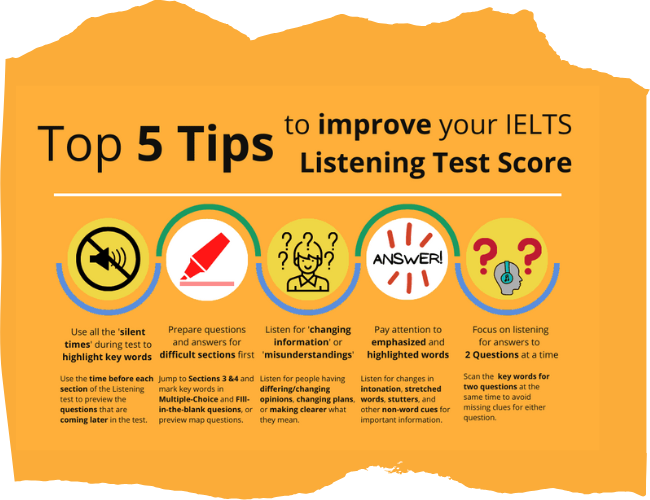
Top 5 Workable Tips And Tricks To Ace the IELTS Listening Section
Read the following pointers to know about the top 5 workable tips and tricks to ace the IELTS listening section:
Decide not to pay attention to every word
The biggest error that IELTS aspirants make is to try to comprehend each and every word in the recording. This seems sensible, but not. The sound plays briskly, and once you’ve considered one of the sentences, the next one is already out the door. Rather, get used to using keywords. Read the questions, and underline important words like names, dates, locations, prices, etc., or special instructions, before the audio begins. These words serve as signaling words. After listening to the information in the recording, the brain is alerted to the related information.
If the speaker says “library membership fee”, your ears should perk up any time they talk about any money, charges, or registration fees. Out of all the effective tips and tricks for IELTS listening, this one is the most important that can save you from losing lots of scores.
Understand how to guess the answer
People who score a high level in IELTS tend to anticipate answers before listening to it. Sounds surprising? However, this is the reality. The majority of students spend this time worrying. You need to constantly ask yourself, will it be a number, a place, a noun, a date, or a person that the answer will be? This technique of prediction is done to condition your mind for future events. When you listen to the audio, you will already know what you are looking for. Suppose that the question is: The event is going to be held on which date? Even if you’re not listening to the sound, you probably know that it will most likely be a day, date, or time. Simple things like this can make huge impacts on your overall score, and are among the most useful tips and tricks for IELTS listening.
Missed answers should not make you panic
This is where most students kill their own performance! You lose one point per answer. Panic enters. Your brain replays the information that you missed as the recording continues to progress. Result? The next two answers are skipped. Be sure to keep this in mind, the IELTS voice does not pause! Forget any answer that is missed; go on to the next one. Emotionally, don’t react to the mistake, but go on to the next question. The ability to remain calm is indeed a listening ability.
Band 9 candidates can easily miss a word or two, but they’re able to make up for it as soon as they are not frustrated and do not waste their mental energy. One of the best IELTS listening tips and tricks is to learn how to control your emotions during the test. It is the concentration that is important, not perfection.
Understand that there is a difference in English
Most students work on only one accent – typically British or Indian English. Then, suddenly, in the real exam, they hear Australian or Canadian accents and are in complete confusion. IELTS is a test of your comprehension of various contexts in which the English language is used. This will allow for variations in accents during the test. To do this correctly, try to get used to a range of accents daily:
- Watch British interviews
- Enjoy listening to Australian podcasts.
- Hear Canadian YouTubers
- For the latest news, tune in to American media outlets.
Initially, using listening accents may come across as weird. You need to know that it is quite normal. However, over time, your ears get used to the sound. The more accents that you hear before you take the exam, the less shocked your brain will be when you take the exam. When it comes to tips and tricks for IELTS listening, this is one of the most underestimated tips in my opinion, as familiarity is what breeds confidence.
Know Spelling & Grammar
Unfortunately, students do sometimes get the right answer and miss a mark due to misspelled words. The IELTS Listening test is stiff. If it is answered ‘environment’ and written ‘environment’, you lose the mark. That’s why spelling practice does not come as an option. Focus especially on:
- Commonly misspelled words
- Plural forms
- Dates and numbers
- Names of places
- Word endings, such as “-tion,” “ment,” and “-able.”
- Grammar matters too.
Seeking an institute for PTE exam preparation? If so, then join the best PTE Coaching for PTE exam preparation under the guidance of expert trainers.
Summing Up
The IELTS Listening test isn’t about being an expert in the listening section of the English language. It’s a matter of the proper listening approach. Once you have mastered the skills of predicting answers, staying relaxed when taking the test, identifying keywords, and accenting different words, the test becomes much easier to handle. Try to practice the ears each and every day. Listen with purpose and not just for the sake of listening. Observe patterns. Learn from mistakes. But above all, believe in the process! But the truth is, your IELTS Listening score isn’t going to get better in one instant of time; it’s going to get better one focused practice session at a time. With the right attitude and the following tips and tricks for IELTS listening, you’re sure to get closer to the band score you’re looking for.

