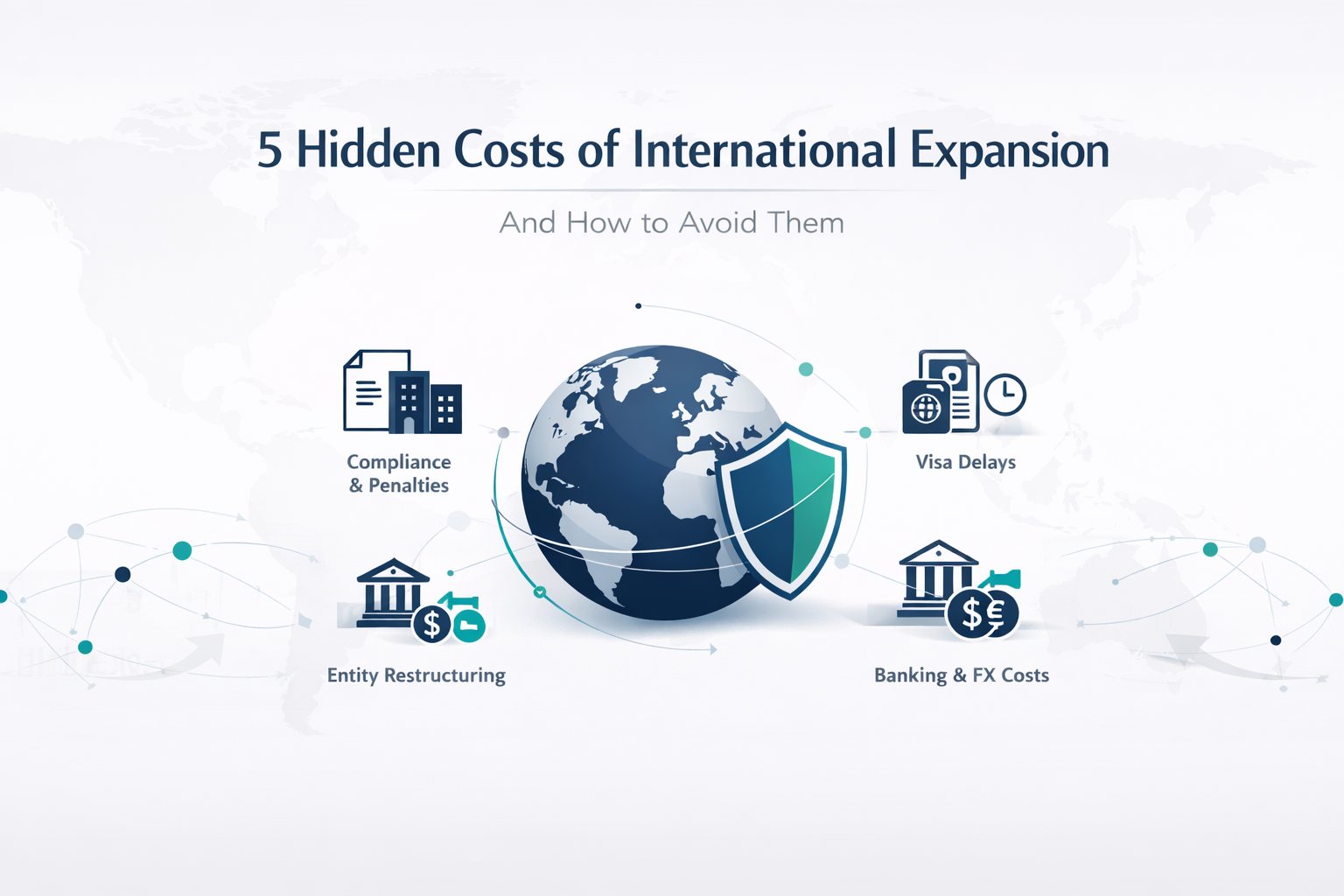
Expanding your business internationally is one of the most significant growth decisions you will ever make. The opportunity is real — new markets, new customers, and new revenue streams. But so are the costs. And not all of them appear on the initial business plan.
Most businesses budget carefully for the obvious expenses: office space, staff, marketing, and product localisation. What they routinely underestimate — or miss entirely are the hidden costs that accumulate quietly in the background and can derail even the most promising global expansion.
Here are the five hidden costs of international business expansion that catch businesses off guard, and how to avoid them.
HIDDEN COST 1: COMPLIANCE AND REGULATORY PENALTIES
Every country has its own regulatory framework — company registration requirements, tax filing deadlines, employment laws, data protection rules, and industry-specific licences. Missing any one of these can result in fines, penalties, or in extreme cases, forced closure of operations.
The problem is that these requirements are rarely communicated proactively. Businesses are expected to know them — and regulators have little sympathy for “we didn’t know” as a defence.
Common examples include:
Failing to register for local VAT or GST before the legal threshold is crossed
Not filing annual returns within the required timeframe
Operating without the required business licences in regulated sectors (finance, healthcare, logistics)
Non-compliance with local data protection laws such as GDPR in Europe
HOW TO AVOID IT:
Before entering any new market, commission a compliance audit specific to that country and your business type. Working with a global expansion partner like Comply Globally gives you access to country-specific compliance expertise across 50+ markets, helping you map every requirement before you begin trading — not after.
HIDDEN COST 2: ENTITY RESTRUCTURING
Many businesses enter a new market quickly — often through a branch office or a distributor arrangement — with the intention of setting up a more permanent structure later. The problem is that restructuring a business entity after the fact is significantly more expensive than getting it right from the start.
Restructuring costs can include:
Legal fees for dissolution and re-registration
Tax implications of transferring assets between entities
Loss of business continuity and client relationships during the transition
Re-negotiation of local contracts and banking relationships
A business that registers as a Branch Office in Year 1 and then needs to convert to a fully owned subsidiary in Year 2 may spend several times what it would have cost to simply set up the right structure initially.
HOW TO AVOID IT:
Invest in entity strategy before you register. The team at Comply Globally helps businesses choose the right entity structure from the outset — taking into account long-term growth plans, investment requirements, and local regulatory preferences.
HIDDEN COST 3: IMMIGRATION AND VISA DELAYS
Sending key personnel to a new market is often critical in the early stages of expansion — you need boots on the ground to build relationships, manage operations, and train local teams. But immigration processes are notoriously slow and unpredictable, and delays can have a cascading effect on your entire expansion timeline.
The hidden costs here include:
Salary costs for employees who are ready to deploy but cannot travel
Lost business opportunities while waiting for approvals
Legal costs for visa applications that are rejected and need to be resubmitted
Penalties for employees who work in a country without the correct authorisation
In some countries, a single immigration misstep — such as working on a tourist visa can result in the individual being barred from re-entering for years.
HOW TO AVOID IT:
Plan your immigration needs 3 to 6 months ahead of yMETA TITLE:
5 Hidden Costs of International Business Expansion (And How to Avoid Them)
HIDDEN COST 4: CROSS-BORDER BANKING AND CURRENCY COSTS
Opening a corporate bank account in a new country is harder than most businesses expect. Many international banks require a physical presence, local directors, or a track record of local trading before they will open an account. This can leave businesses unable to receive payments or pay local suppliers for weeks or months.
Beyond account opening, ongoing banking costs add up:
Foreign exchange conversion fees on every international transaction
Wire transfer fees for cross-border payments
Minimum balance requirements that tie up working capital
Compliance costs for international banking regulations (KYC, AML)
For businesses managing operations across multiple currencies, unmanaged FX exposure can significantly erode margins — particularly in volatile currency environments.
HOW TO AVOID IT:
Research your banking options early and consider multi-currency accounts or fintech alternatives that offer better FX rates and lower fees. For complex cross-border banking needs, Comply Globally’s cross-border banking and finance services (https://complyglobally.com/cross-border-banking-and-finance/) help businesses establish the right banking relationships and manage international payments efficiently.
HIDDEN COST 5: LOGISTICS AND CUSTOMS DELAYS
For businesses that sell physical products, international logistics is one of the most complex and costly areas of global expansion. Import duties, customs documentation errors, and regulatory non-compliance can cause shipments to be delayed, rejected, or confiscated — all of which carry significant financial consequences.
Hidden logistics costs include:
Storage fees for goods held at customs
Expediting fees to prioritise clearance
Fines for incorrect or incomplete customs documentation
Product re-labelling or re-packaging to meet local standards
Cost of lost or damaged goods during transit due to inadequate insurance
Trade regulations also change — tariff rates, import restrictions, and country-specific documentation requirements can shift with little notice, catching unprepared businesses off guard.
HOW TO AVOID IT:
Work with a logistics and customs specialist who understands the specific requirements of your target market. Comply Globally’s customs and logistics services and EXIM expertise ensure your supply chain is compliant, efficient, and resilient to regulatory changes.
THE COST OF GETTING IT WRONG VS THE COST OF GETTING IT RIGHT
It is tempting to view compliance, legal, and logistics support as costs to be minimised. In reality, they are investments that protect against far larger losses. The businesses that underinvest in these areas early almost always spend more correcting problems later — and in the worst cases, they exit markets entirely having lost significant capital.
The businesses that expand successfully and sustainably are those that treat compliance, entity strategy, immigration, banking, and logistics as core components of their expansion plan — not afterthoughts.
HOW COMPLY GLOBALLY HELPS BUSINESSES AVOID HIDDEN COSTS
Comply Globally is a global expansion and compliance partner that helps businesses navigate the full complexity of international growth across 50+ countries. Their services span:
Entity formation and ongoing compliance management
Work visa and immigration support
Cross-border banking and finance
Customs, logistics, and EXIM services
HR and employment compliance
By consolidating these services under one roof, Comply Globally eliminates the coordination gaps that lead to hidden costs — giving businesses a single point of accountability for their entire global expansion.
If you are planning international expansion, start with a free consultation to understand what your specific target markets require and where the risks lie.
CONCLUSION
International expansion is not just a revenue opportunity — it is a risk management exercise. The businesses that succeed globally are the ones that plan for the full cost of expansion, including the hidden ones. With the right partner and the right preparation, those costs become manageable — and the opportunity becomes achievable.
ABOUT THE AUTHOR:
DR. ANIL GUPTA is a Chair of the Comply Globally with experience in international business expansion and global compliance strategy. This article is written in partnership with Comply Globally, a global expansion and compliance partner supporting businesses across 50+ countries.